

Europe’s Nicotine Crackdown Risks Turning a $10 Billion Market Over to Illicit Sellers
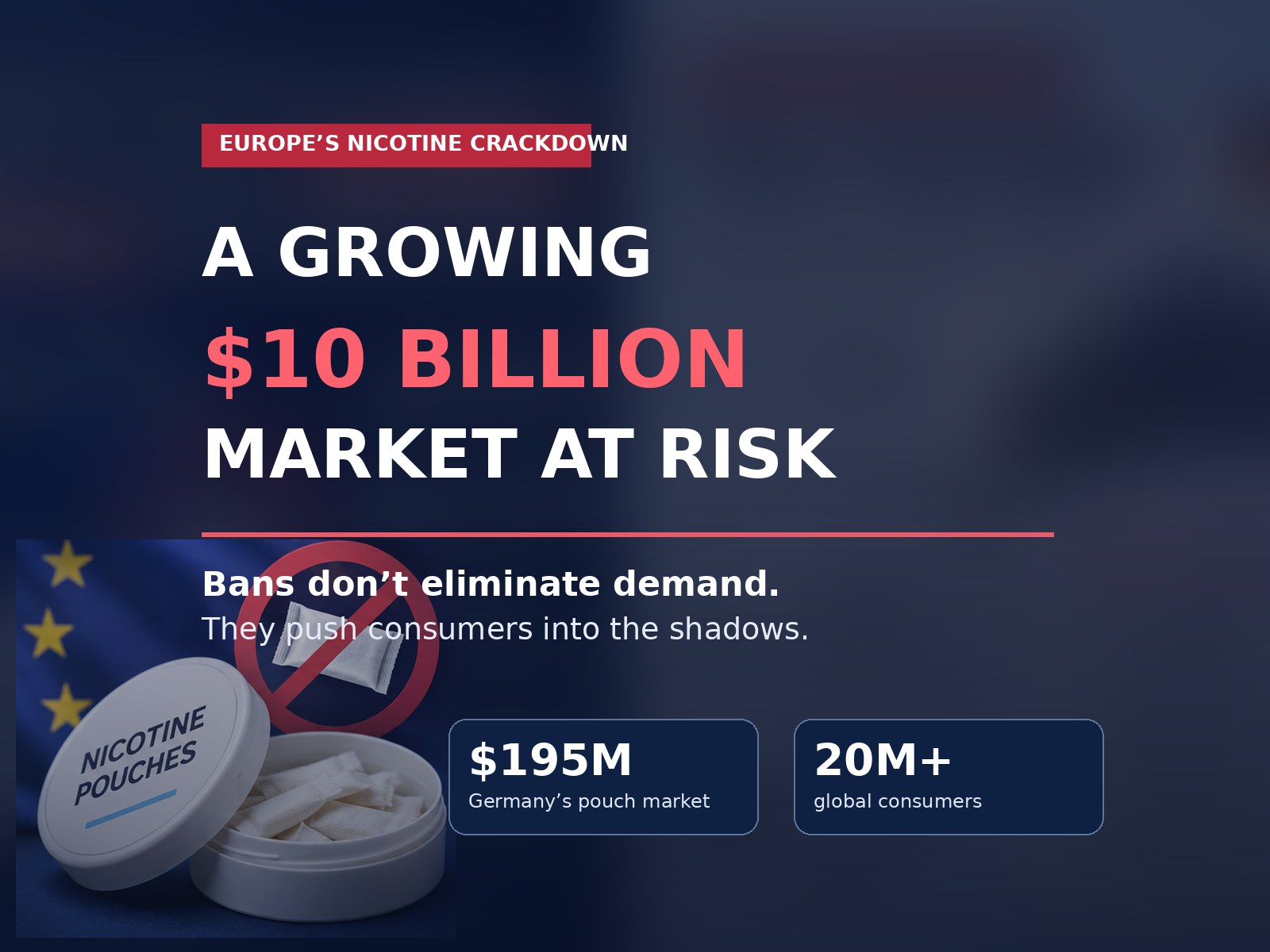

Germany has effectively banned nicotine pouches since 2021. Yet the country remains the world's ninth-largest market, with around one million adult consumers purchasing an estimated $195 million worth of products annually. Rather than eliminating demand, prohibition has ensured that consumers must turn to suppliers operating outside the legitimate regulatory market.
This is among the findings of a major new international study by TobaccoIntelligence, which examines how bans, excessive taxation and restrictive regulations are fuelling illicit nicotine markets worldwide. The report, independently prepared by TobaccoIntelligence, provides further evidence for what we have been arguing all along - that increasingly aggressive restrictions on reduced-risk nicotine products are not only failing to achieve their stated objectives, but actively undermining consumer protection and public health.
Nicotine pouches now represent a $10 billion global market, with more than 20 million consumers and annual growth of 44%. Millions of adults across the globe have either quit or reduced their smoking as a result of these product, potentially leading to hundreds of thousands of lives saved. As demand continues to increase, governments face a fundamental choice between establishing effective legal frameworks or allowing illicit suppliers to capture an expanding market while forcing smokers to continue smoking combustibles cigarettes – with deadly consequences.
The German findings reinforce those of Prohibition Does Not Work's own investigation, which documented how the country's de facto prohibition has created a substantial illicit market while denying its more than 17 million smokers access to a regulated, less harmful alternative.
Furthermore, the country has shown only a modest decline in smoking from 30% in 2006, and no progress since 2017. In the past five years since the implementation of the de facto ban the decline in smoking rates completely flatlined. This stagnation of the decline in smoking rates is attributable to two factors. Firstly, many consumers who may benefit most from switching or from avoiding smoking altogether tend to be law-abiding, health-conscious individuals. These consumers are deterred by the illegality of the products. Without legal access and regulation, nicotine pouches lack the credibility and safety assurances, and due to the lack of regulation smokers can loose the angle of nicotine pouches as a safer alternative.
Meanwhile, black market pouches are more often used by individuals drawn to risky or transgressive behaviours such as youth or thrill-seekers. Their uptake of illicit nicotine products therefore does little to reduce overall smoking rates. In effect, the ban has unintentionally restricted access to one of the safest nicotine delivery methods, limiting its potential public health benefit.
Elsewhere, the study identifies similarly troubling results. In France, which banned nicotine pouches in April 2026, an estimated 200,000 adults continue to use the products, with a market worth $34 million. A July survey found that 56% of pouch consumers were not even aware of the prohibition. In Finland, where online sales restrictions and heavy taxation have been imposed, 94% of nicotine pouch-related online traffic in 2025 was directed towards foreign websites. In Denmark, researchers identified twice as many nicotine pouch brands available online as had been officially notified to regulators.
Perhaps the clearest warning comes from Norway, where authorities have proposed limiting nicotine strength to 12 mg per gram. According to TobaccoIntelligence, 68% of surveyed consumers currently use stronger products. Its modelling suggests the restriction could double the proportion of consumption on which domestic duty is not paid, from 17% to 34%. The report also finds that ultra-strong pouches containing up to 50 mg of nicotine are most commonly encountered in markets where products are banned or subject to extremely low nicotine limits. Restrictions intended to protect consumers may therefore encourage the very products they are designed to prevent.
These findings are consistent with the growing body of international evidence documented by Prohibition Does Not Work. Our investigations into Australia have exposed how restrictive vaping policies have fuelled a billion-dollar black market accompanied by organised crime, violence and widespread illegal sales. Our reports on Brazil and Mexico have documented how outright prohibitions have failed to prevent millions from vaping while creating lucrative opportunities for criminal organisations. Most recently, our research into the Netherlands found that the country's flavour prohibition has driven consumers towards illicit suppliers, while youth vaping rates rose from 3.7% to 7.6%. Across different countries and regulatory approaches, the evidence points to a consistent failure to eliminate demand through prohibition.
Yet despite this mounting evidence, European governments are now advocating even more restrictive policies.
On October 6, eight EU member states called on the European Commission to impose a sweeping freeze on new nicotine products, alongside strict nicotine limits, broad flavour prohibitions and restrictions on cross-border sales. Their proposals would also allow individual member states to prohibit nicotine pouches outright.
These are precisely the types of restrictions whose consequences TobaccoIntelligence has thoroughly documented. Introducing them across Europe risks expanding illicit trade, undermining legitimate businesses and exposing consumers to products beyond effective regulatory oversight.
As the European Commission prepares to revise its Tobacco Products Directive and consider new nicotine taxation measures, it must take seriously the overwhelming and irrefutable international evidence. Proportionate, risk-based regulation, reasonable taxation and effective enforcement offer a far more credible approach than the failed policies of prohibition which lead only to black markets, criminal activities, and more people smoking and dying as a result.
Stay up to date
Join our mailing list for expert insights and global updates.
